Archive for the ‘Night’ Category

Seven Days of Night part 1

Thursday, November 18th, 2010

I recently returned from a road trip with a very special twist.
It started with an opportunity to attend The Pearsonville Workshops, a unique night photography experience that takes place in an old-school car junkyard in the southern Mojave Desert.  Hosted by my good friends and night photo gurus, Troy Paiva and Joe Reifer, it was my second opportunity to get access to this incredible location during a full moon.
It also fell right at the beginning of my 10 day vacation.
The Mojave is an amazing place to shoot day or night, and with my father, Barry, and friend, Heidger, already on board to take the workshop, why not extend 3 nights of shooting to a full week?
With our tripods extended over a sacred stone, we pledged to photograph for seven straight nights, exploring what was later to become a very surreal journey from the Mojave to Mono Lake.

This mostly desert area of the now Eastern Sierras of California was once connected by a chain of inland lakes that stretched from Mono Lake to Death Valley.
Now it is connected by the scenic Interstate 395.
But 10,000 to 100,000 years ago calcium-rich groundwater and alkaline lake water combined to grow tufa formations deep beneath the Searles Lake, which encompassed much of the now Southern Mojave Desert.
Today, the Trona Pinnacles has over 500 tufa formations rising from the bed of the Searles Dry Lake Basin.
And so we chose this amazingly surreal geological wonder to be Night 1 of our trip.
Barry, Heidger, Susan and I piled into my car and we drove the 20 miles from Ridgecrest to Trona.  “Watch for the marker signs on the right that will lead you down a dark dirt road to the Pinnacles.” Joe had warned us.   Highbeams lighting the way, we lumbered down the gravel road passing railroad tracks and…signs for Aero Films Company?

When we finally reached our destination, there were two large white storage trucks waiting for us with their motors running.  We approached the driver, who was probably more surprised to see us than we were to see him!   They were with Aero Films and were guarding all the film crew’s gear for a car commercial that was to be shot there early the next morning.   We chatted it up with Steve and told him that were on a photographic mission and would be shooting for the next few hours.  He agreed to turn off his headlights if we agreed not to shoot near his vehicles.  This wasn’t a problem and it was one of the friendliest encounters I had ever had with a security official at a night location. The Trona Pinnacles is part of the BLM and has no rules against photographing or camping at night.

So for the next 4 hours we wandered through the 30′-40′ towers of the “Cathedral City”  letting the moonlight guide our way. The night-light only heightened this surrealscape which reminded me of Turkey’s Capadoccia Region.  The incredible thing about Capadoccia was that people actual carved into these tufa formations and created homes, churches, and an incredible hidden city.  We didn’t get to explore all of the Trona Pinnacles, but we saw no sign of any past human inhabitants!

Nights 2, 3, and 4 were spent under the tutelage of Joe Reifer and Troy Paiva as we explored the expansive Pearsonville Junkyard.
Known as the hubcap capital of the world, Pearsonville features an incredible collection of cars from the 30′s -70′s as well as a race track.  The track hasn’t been used for years, in fact the junkyard as a whole probably has a limited lifespan.  So, if any of these images inspire consider taking the Pearsonville Workshops in 2011, while supplies last!

Now, I’m not really a car guy.  Whenever they ask me what vehicle I’d like to rent I always reply:  “A roomy one with an auxiliary or usb port!”
However, just like the Trona Pinnacles, when the sun goes down, the moon turns this junkyard into a post apocalyptic landscape.
And I do like that!
The Full Moon greeted us on Night 2, which was coincidentally the Autumnal Equinox.  This Super Harvest Moon signals the change of seasons and hasn’t directly fallen on the Autumnal Equinox for 19 years.  It was a beautifully clear night, so a few of us scouted out locations to catch the moonrise.  The days and nights share almost equal time around the equinox, so there was a very good chance to catch the moon rising while there was still a few licks of daylight left in the sky.  This would have been heightened more if there would have been any clouds in the sky to reflect the fading sunlight.  I chose a hollow old car to shoot through as the moon began to rise, see image number 4.

The nights were pretty warm, in the upper 70s, and this actually affected how we captured our long exposures.
For digital capture I prefer to shoot my Nikon D700 at its native ISO of 200 and expose for 6-8 minutes during a full moon.  I also prefer to turn my Long Exposure Noise Reduction filter off.  All SLR cameras have noise reduction filters that can be turned on or off.  If you have it turned on, once your exposure is compete, the camera will take another “picture” of a black frame and stack it onto your previous image.  This stacking of images is called “dark frame subtraction” and is basically a little “in camera photoshop” that minimizes the amount of noise in your image.  Great you say, but in most cameras this dark frame subtraction usually takes the same amount of time that you exposed the original picture.  So an 8 minute exposure is now a 16 minute exposure with noise reduction on.  That’s right, you can’t fire your camera or press any buttons until the dark frame subtraction is complete.  This also drains your camera battery quickly and is definitely not the most productive way to photograph.
A good way to check how your camera is handling the long exposure noise is to take a photo without the NR filter on and then zoom into the image on your LCD screen.  Try to get a portion of the sky in your image as it is easy to find noise there.  If you find red spots in the sky, you’ve got noise.
As it turned out, most of us were experiencing noise at exposures of 4-6 minutes, so we had to make a choice:  shorten our times or sit and wait for our cameras.
I ended up doing a combination of both.  Shorter exposures can lend themselves to being stacked nicely post-process and achieve nice long star trails.  Joe has a great explanation on how to do that on his blog.

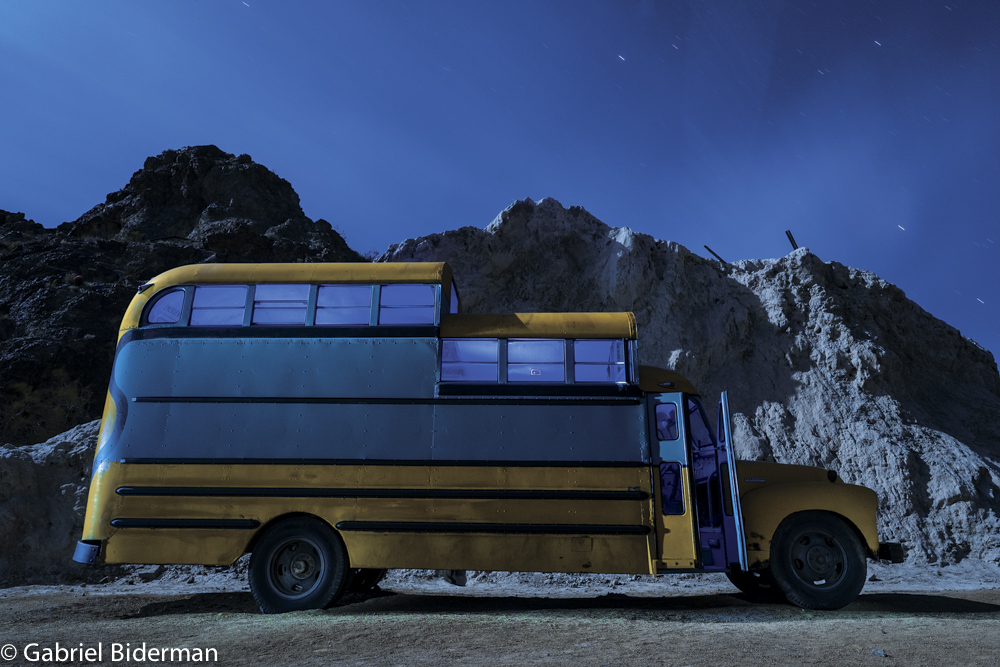
Joe and Troy are excellent educators, each sharing their two distinct night visions with our class of 12.   I tried to spend a few hours each night and sponge some of their light painting and other night techniques.  In most of my images I tended to move in close and reinterpret the vehicle.  However I do feel you get a better sense of the space in the images where I stepped back and shot, the RV and abandoned rear end of the car for example.  It is easy to get lost within yourself at Pearsonville.  You walk 2 feet and another cool car or shape takes form before your eyes.  The lot isn’t that big but with close to 600 cars, I’ve barely scratched the surface!
By the end of the Night 4 there was still a large area of the lot that I had not explored.
Troy and Joe have logged in close to 30 nights each at Pearsonville and they are still finding new work.  You have to check out Troy and Joe’s body of work.  Their images will blow your mind and Joe’s blog offers some of the best guidance on night photography on the web.
You can find the Pearsonville 2010 Fall class’ work on Flickr.
I also enjoyed revisiting my images and blog from my last trip out to P-ville back in the spring of 2009.

Sleepy Hollow Cemetery Night Photography Workshop

Sunday, September 5th, 2010

Hosted by
Sleepy Hollow Cemetery
Limited Availability!!!

Date: Saturday September 18th 2010

Instructor: Gabriel Biderman

Where: Sleepy Hollow Cemetery, 540 North Broadway, Sleepy Hollow, New York.

Cost: $95

Gabriel is very excited to be able to offer this unique one night photography class in the legendary Sleepy Hollow Cemetery.
With over 90 acres of old sculptures, mausoleums, and tombstones dating back to 1850, Sleepy Hollow is one of the most sought after historic cemeteries in the country.

Gabriel will lead you from dusk until midnight and help you capture the spirit of Sleepy Hollow. The class will explore how images are created when you go beyond the fleeting moments of time and expose your camera for seconds and minutes.
In this 7 hour workshop, you will learn light painting techniques that will enhance the many beautiful details of the cemetery. You will also focus on using the moonlight and star trails to enhance the night sky.
Gabriel Biderman is a self-taught photographer who has been specializing in the fine art of the long exposure with everything from pinhole to the latest digital cameras. He will go into detail on how to meter and process your long exposures using either film or digital capture.

Please click here for additional information & to sign up for the workshop.

Orpheus ~ The Open Air Cinema of Kos

Wednesday, July 21st, 2010

We just got back from 10 days on the Greek Islands that culminated in an amazing Greek Wedding in Crete.  1,762 images were shot during that time, but let’s start with the first adventures on the island of Kos.
Ancient and Modern Greeks love to be entertained.  It is no surprise that the few buildings that have survived from Ancient Greece are either Theaters or Temples.
America has her drive-ins theaters that started in the 1930′s; Greece introduced their first Open Air Cinemas or Therini Kimimatografiin in 1919.  Like the drive-in, they went out of fashion in the 60′s-80′s.  But now, the romance of a movie under the stars, or even under the Acropolis, is back and Greeks and tourists alike are flocking to these nostalgic venues.
Once Nancy and I had checked into Hotel Americana, we strolled towards the city center of Kos and stumbled upon The Orpheus outdoor cinema.  It was early afternoon and a women was struggling to open the front gate.  I excitedly approached, probably too much American coming at her too fast, but she slowly understood that we would like to peak inside the theater if possible.  The gate finally clicked open and she let us slip in.  She was coming in to clean the theater in preparation for tonight’s 9pm show.  It was a mess, typical of any movie theater, people left there garbage everywhere after  the show.
But it was beautiful.
Vines, jasmine, and Bougainvillea grew all over the 2 side walls that enclosed what appeared to be an outdoor cafe.  Approximately 80 chairs and 20 tables where set up in front of the beautifully white screen.
Click Click Click.  I turned to Nancy and we immediately knew what we were doing for our first night in Greece.  Going to see……The Prince of Perisa?
You’ve got to be kidding me?  They’re showing a Hollywood Persian Action film in Greece?!
They’ve been enemies for over 2500 years, oh Alexander the Great is surely spinning in his grave!
We got there early for the 11pm show,  I wanted to find the manager and ask if I could set up two tripods and cameras to capture the theater at night, during a long exposure.
The ticket taker pointed me to a man who was smoking a cigarette and chatting with someone right before we walked into the theater.  I showed him my tripods and explained that I’d like to take some pictures of the theater during the movie.  I’d sit in the back and not use flash and promised not to disrupt anyone.
He really didn’t care, as long as I paid for my admission.
So in we went, and I set up in the last row, in front of the concession stand.
Two tripods, two cameras; one digital, and one film.  Hey, I got permission, so why not go all out!
About 30 people were settling into their seats, no one seemed interested in me until the credits started rolling and then an older gentlemen, in broken English, asked me what I was doing.  I told him that I was documenting the theater.  He told me I couldn’t take pictures during the film but I assured him that I had permission and the ticket taker who was now running the concession also backed me up.  He didn’t want to, but he let me be.
I set the film camera to expose…the exposure which you see below was for half the movie or about an hour long.  The quick digital test shots proved that an 8 minute exposure was adequate at f/11.  It was probably in the high 70′s and the mosquitos were now beginning to attack Nancy.  Another beautiful aspect of the Greek Cinema is that they do not dub non-Greek films.
Though I don’t think a good dubbing would have helped The Prince of Persia.
Another thing typical to the Greek Cinema, there is always a halftime.
Usually it is a mad dash to go out for a smoke, but at the outdoor cinema you are allowed to puff as much as you please.
Our friend, who I know think was the projectionist, came down to see me as the 2nd half started.  He told me I definitely had to stop taking pictures.  He was citing that the movie industry owned the rights to the movie and no recordings were permitted.  I showed him the back of my screen and pointed out there were no images being captured, just the white screen and the theater.  The images kind of threw him, but he was determined that I stop and take down my rig, so I did.  I had captured what I came to capture and was now testing out some new compositions and didn’t want to cause a scene.  As we broke down the tripods, the woman from the concession stand sounded like she was telling our friend to chill out.
No worries, I told her, I appreciated the chance to capture the cinema and gave her one of my cards.
As we pass the halfway mark of the summertime, take a look around; lots of Therini Kimimatografi can be found, not only in Greece, but here in America.  So enjoy the magic under the stars!

New updates to the Ruinism website

Friday, June 11th, 2010

My awesome web designer, Sean Thompson and I have recently revamped the entire Portfolio section of this website.  Check it out and I would love to hear any feedback.

The first section is titled Ruinism. This is an ongoing project of mine that started with my love for mythology and visiting ancient ruins. Over the years I’ve incorporated modern ruins as I try to capture the timelessness and spirit of the place. Ghosts and nudes will sometimes be seen in these spaces and add a sense of beauty to the decay.

All images are part of a bigger storyboard that is often unknown.
The theme Exposures is based on capturing a mysterious moment in that bigger story. These images will often make you ask, “What is it?” “What just happened?” or “What will happen?”

Two new themes have also been added, Time Exposed and The Bridge Project.
Time Exposed is a collection of my photographs that focuses on the passing of time around a single exposure. Taken mainly at night or with a pinhole camera during the day, I seek to focus on the capture of time itself and the unseen moments that happen between the seconds, minutes and hours of time exposed.

The Bridge Project is my most recent ongoing theme. Bridges are modern marvels.
These solid structures often will lead you over a dangerous chasm of water or rocks. I try to heighten that dichotomy of order and chaos in each image. Some bridges are famous but most others are simply utilitarian, however each has a story to tell.

The image above is titled the Cylon bridge.  It is the Roosevelt Lake Bridge or sometimes referred to the Roosevelt Dam Bridge because it replaced traffic that was driving over the Roosevelt Dam in 1990.  This image has quickly become one of my favorite images and is a nice long exposure of 10 minutes shooting due north.  Click on the image to enlarge it as well as see the other exposure details.  Nancy and I stumbled across this bridge while we were driving on the Historic Route 88 in Arizona.  We had just visited the Hoover Dam a week before and when I saw there was another Dam along this road, well we realized we had committed to a Dam Tour.
Sorry.

I later found out that the The Roosevelt Dam Bridge spans 1,080 feet across Roosevelt Lake and is the longest two-lane, single span, steel arch bridge in North America.  The original dam-top roadway was designed to allow two Model-T Fords to pass abreast, but today’s recreational vehicles and full-size automobiles are too wide to permit two-way traffic.
This info and more can be found here.
I’ve also included an image of the Roosevelt Dam so we can see the entire picture.  I consider myself a manscape photographer,  I like to incorporate man made structures with the landscape.

What else did you think I meant?