Archive for the ‘Photographers’ Category

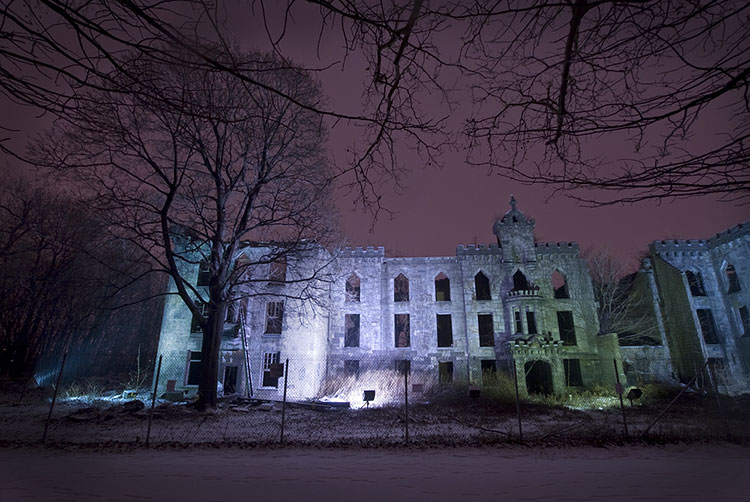
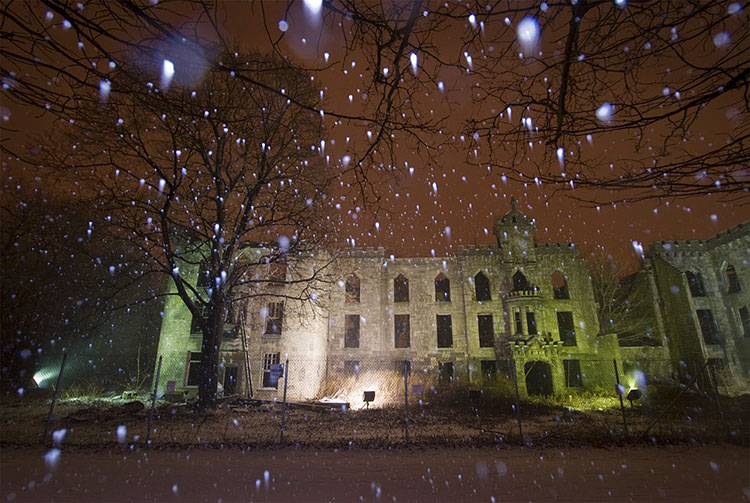
Renwick Smallpox Hospital

Thursday, March 6th, 2008

DSC_4598_1email.jp

The year is 1856.
You are huddled with hundreds of sick people on a ferry along the East river.
The distant foghorn blasts 3 times and as you push yourself closer to the edge of the boat, the mist begins to lift and reveal land and a castle…
People are there to greet you, people and crates.
Actually those aren’t crates, they are coffins, they are definitely occupied and there are hundreds of them.

This was the scene at the Renwick Smallpox Hospital, which was located at the southern tip of Blackwell Island, halfway between Manhattan and Queens.

Designed by the architectural genius, James Renwick Jr., the hospital was built for the modest sum of $35,000 from 1854-6. Of course, it’s easy to keep your overhead low when you have free labor from the island’s prison population and a quarry of gray gneiss at your doorstep.

James Renwick Jr. entered Columbia at the ripe age of 12, and was a major player in the Gothic revival period. His first commission was New York’s Grace Episcopal Church and he continued his amazing career by designing St Patrick’s Cathedral, Corcoran Gallery of Art, and the Smithsonian Institutional Building among others.

The Renwick Smallpox Hospital was the first in the nation to accept patients with this plague or other contagious diseases like scarlet fever, measles, and typhus. It was built to hold a few dozen patients, but from the beginning it was severely overcrowded. Records indicate that it treated 3000-4000 patients in the 1850′s and over 6,000 during the 1860′s. If you were rich and sick, $1 a day would get you onto the top two floors. If you were poor, you were relegated to the first two floors, where several patients would be assigned to one bed in truly appalling conditions. $5 extra a week got you marginally better food, but the percentage of people to walk out Renwick’s doors cured was barely over 60%.

The Renwick Hospital became known as Deadhouse and The Pest House because of the thousands of coffins it ushered out its doors. Even though there was a cure for smallpox in the early 1800′s, it was expensive and 1 out of 100 would die from the vaccine itself. George Washington survived the smallpox disease, and Lincoln battled a mild case 2 days after giving the Gettysburg address.

Over time, and with the decline of this disease, the hospital was expanded and turned into a very respectful nurse’s training facility. However, Renwick’s Hospital was feeling the weight of its years and was seriously antiquated by the 1950′s and starting to crumble in the 60′s. In those years there were very few preservationist groups and few landmarked buildings, but by the 1970′s the Renwick Smallpox Hospital was officially declared a Landmark.

An anonymous donor in 1993 had floodlights installed to cast an eerie evening glow onto the facade of the Hospital. Spectacular views of “Manhattan’s Castle” can be seen at night driving along East side river or flying into LaGuardia Airport.

Since moving here in 2001, I have been fascinated with this building and have tried to shoot it. However, walls and barbed wire fences have been most prohibitive. In late January 2008, a good friend and fellow pinholer, Tom Persinger suggested a Smallpox Hospital Photo Shoot. His father lives on the the former Blackwell Island, now called Roosevelt Island, and said the southern tip was quite accessible. The State is currently in the process of a $12.9 million ‘Phase One’ project to stabilize the Renwick ruins and build a public park and have already landscaped pathways at the southern end of the Island. This project is trying to be sped up due to the collapse of Renwick’s north wall on December 26 of 2007.

So Tom and I ventured out on a cold afternoon with the talented Holga and Zone plate phenom, Erin Malone. There’s a chain-link fence surrounding the Smallpox Hospital and I, of course, quickly found a not so legal way around it. Not much was left inside the Hospital but piles of bricks and plenty of trees. The facade, the framework, was really all that remained. I was having some technical difficulties shooting that day and vowed to come back…at night.

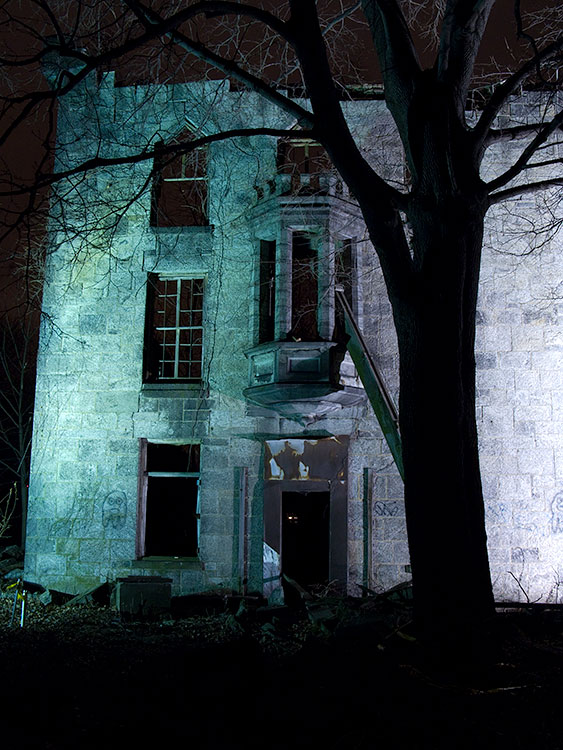
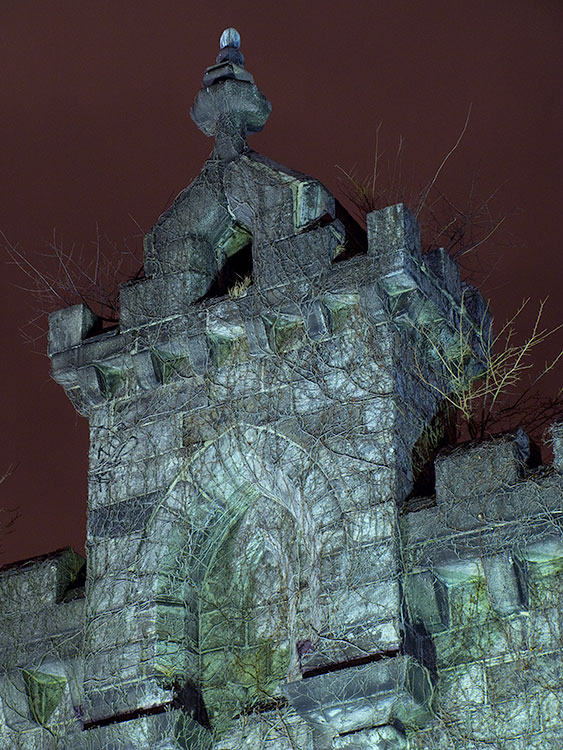
I went on a scouting mission on February 6th, 2008 to see if it was even accessible at night. The sun was setting by the time I arrived at 5:30pm. The main gate to the southern tip of the island was over 10′ tall and had barbed wire, but it was open. With tripod and my new Canon G9 in hand I quickly rushed down the 60+ yards to the Hospital. I didn’t want to break in at night, I just chose to shoot through the fence and test the exposures. The floodlights were bathing the Hospital in what seemed like white light but my camera was reading as eerie shades of blue and green.

An hour later I was still shooting when the cop car drove up beside me, “We closing up bossman” said the driver.
What? Bossman? I wasn’t being arrested?
Technically, I wasn’t trespassing.
I asked the cop what time they shut down the park to which he replied, “Around sunset, or when it starts to get dangerous.”
“Dangerous?!” I replied, “Well, thanks for the warning.” and started to walk back towards the gate.
Unfortunately the gate was now closed and locked.
Uhmmm… I definitely was assessing the situation and it didn’t look good. But then the cop car came back around from doing his loop and thankfully unlocked the gate.

The next week I returned with my fellow Nocturnalist, Andre Costantini, who was featured previously here with our Red Hook Night shoot.
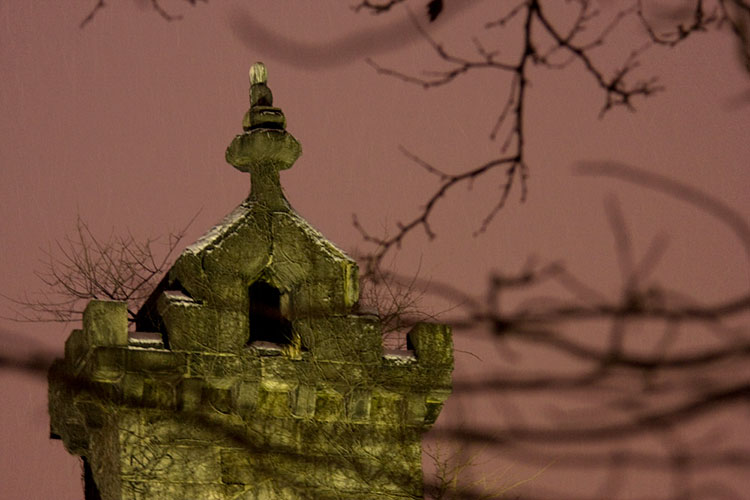
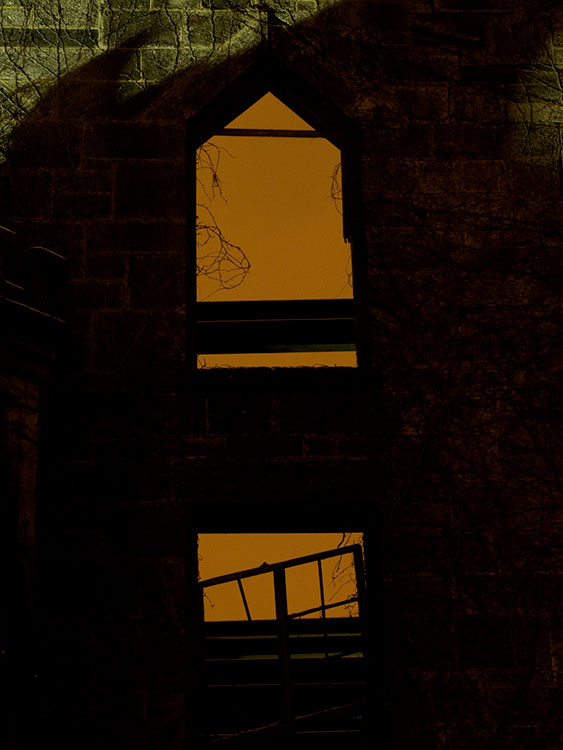
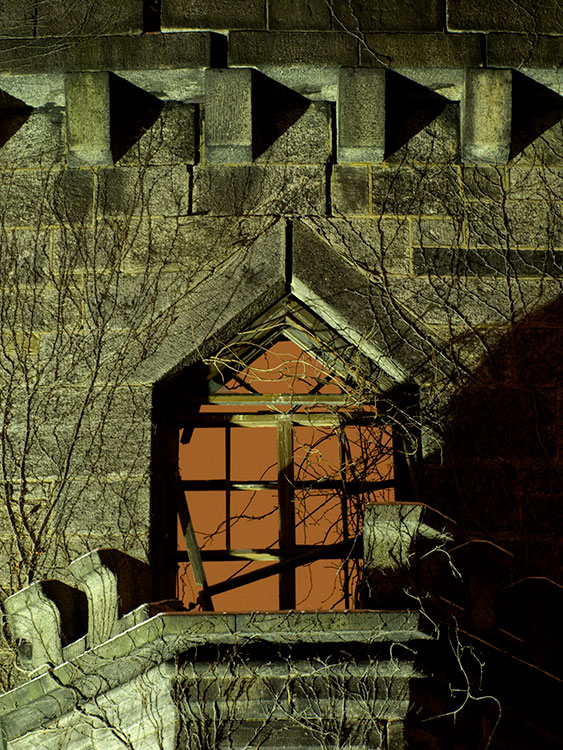
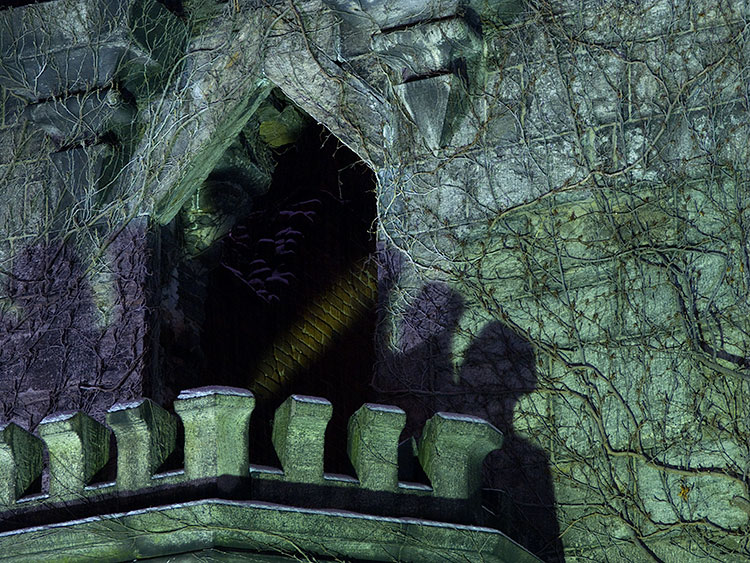
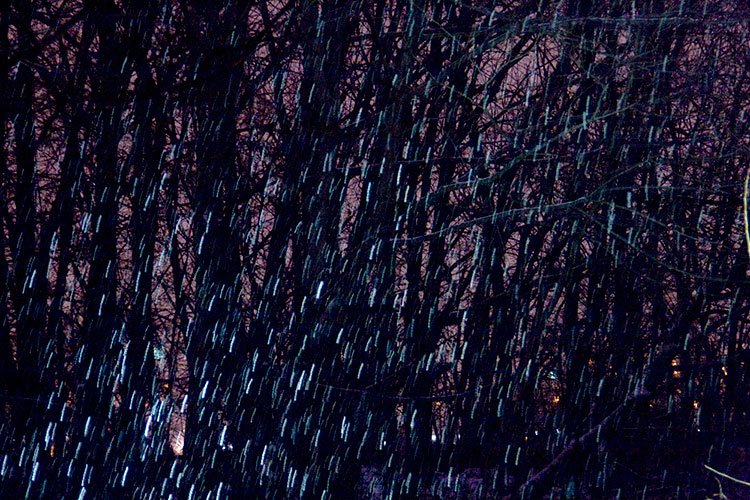
As luck would have it, February 12th, 2008, was one of the few days in which it snowed in the city. Did that deter Andre and me? Hell no! We arrived at 5pm, set up, and witnessed an amazing sunset through the snow clouded night. It was truly spectacular, and the images featured here are the best of both or our work from that evening.
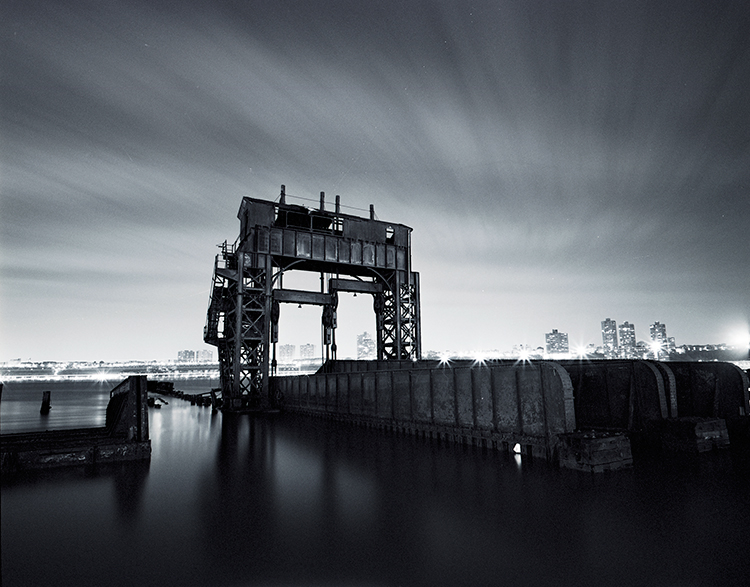
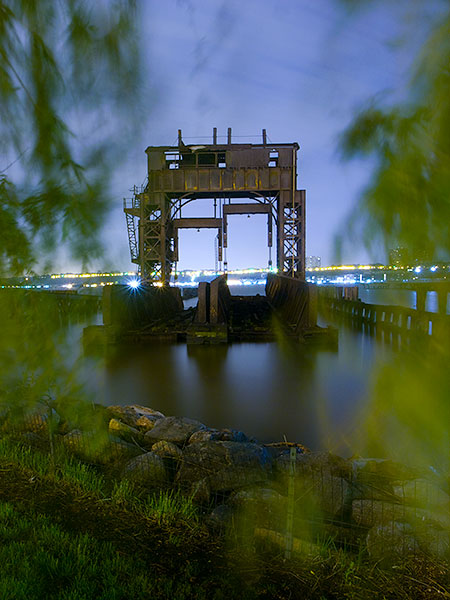
(Click on each of the photographs above to see the artist and larger image size and details.)

It truly was a great shoot under the aura of this ancient castle. Of course the same cop, Ray, came to get us at 7pm, “We are closing up bossman.” he said again from the police car. Because I knew the drill and it was cold outside, I asked Ray if he could give us a lift to the train station which was a 5 minutes drive away. “Come on in, did you get some good shots tonight?” Ray asked as Andre and I jumped into the cop car and headed home.

(Historic information regarding this blog was taken from several of Jami Bernard’s articles from Roosevelt Island’s Independent newspaper, Main St WIRE and from the Roosevelt Island Historic Society.)

Sutro Baths part 2

Monday, December 24th, 2007
Joe Reifer Andy Frazer Andy Frazer Shawn Peterson
Shawn Peterson Sutro 7 - Gabriel Biderman - Ricoh GRD 28mm lens 3 min. f/4 ISO 64 Sutro 8 - Gabriel Biderman - Ricoh GRD 28mm lens 3 min. f/5.6 ISO 64 Sutro 3 - Gabriel Biderman - Mamiya 7 65mm lens Tri-X 400 8 min. f/11

Modern ruins, labyrinthine structures, wind blown cypress trees clinging to the cliff, and caves and paths that lead to Land’s End; this is the Sutro Baths that I’ve been fascinated with since I was first taken to Ocean Beach as a young child.
The Sutro ruins on the outskirts of San Francisco are where we’d often take the dog hiking along the paths above or exploring the abandoned remains below. This probably set in place my future fascination for Ruinism. The Sutro Baths are no secret and have been welcoming the public and the Pacific in one way or another for over 110 years.
Built with iron, wood, and glass in the grandiose manner of London’s Crystal Palace, the grand opening to the public was held on March 14, 1896. The Industrial Age was in full swing and this engineering masterpiece had taken only 6 years to build at the cost of $1 million. It was the dream of the eccentric Adolph Sutro, who had just finished a lackluster 2 year term as San Francisco’s 24th mayor. The extravagant public bathhouse was the world’s largest indoor swimming pool at that time and was inspired by the ancient baths of Rome. Visitors to the baths had 7 different swimming pools to choose from, one freshwater and six salt water bathes, ranging in temperature from 80 degrees to sea temperature. During high tides, water would flow directly into the pools from the Pacific, recycling 2 million gallons of water in an hour. During low tides, a powerful turbine water pump, built inside a cave at sea level, could be switched on from a control room to fill the tanks at a rate of 6,000 gallons a minute. Over 20,000 swimsuits were for rent and the facility could hold over 10,000 people at a time. To see an Edison Manufacturing Co short film of the Giant Slide at the Sutro Baths from from 1897 click here.
If you preferred not to swim, the bathhouse also incorporated a museum displaying some of the finest Egyptian artifacts outside of Egypt as well as Sutro’s varied personal collection of his travels. An 8,000 person Concert Hall and an ice-skating rink were also part of the Sutro Baths.

Five hundred dressing rooms … spacious elevators and broad staircases … pavilions, balustrades, promenades, alcoves and corridors adorned with tropical plants, fountains, flowers, pictures, … the collected treasure of foreign travels… a portico with four Ionic columns and pilasters which lead to a noble staircase, wide, gradual of ascent, bordered with broad-leaved palms, the flowering pomegranate, fragrant magnolias … [touching] the very rim of the reveling waves.

However, due to the high operating and maintenance costs, the Sutro Baths closed its doors in 1966. During its demolition, a suspicious fire broke out and left the Baths in the ruins that you can see today.
What has fascinated me most is how little the ruins have changed. They are maintained by the National Park Service and very little is off limits for urban exploration.
Our “exploration” led to the photos that were taken on November 24th. It was a full moon, and my father and I met fellow nocturnalists Joe Reifer, Andy Frazer, and Shawn Peterson as the few clouds were breaking through to reveal the ruins of Sutro. We spent over 4 hours shooting, flashlights popping, and exposures being calculated. Armed with tripods, our exposures were running 2-8 minutes, with plenty of opportunity to soak in the true atmosphere of the baths. I’ve spent a lot of time at Sutro, but on a clear night with old and new friends, we explored the timeless time of Sutro.
To check out more of Joe Reifer work click here.
Andy Frazer’s blog on the night can be found here.
More of Shawn Peterson’s nightwork can is here.

To see some great photos from old Sutro Baths or read more about its history check out these sights:

Sutro Baths
Cliffhouse Project
Sutro’s
Outsidelands
Wikipedia

Red Hook Nights

Tuesday, November 20th, 2007
Visitation St Beard St Warehouse sugar factory boat
beard lady liberty diamond trolley 2 gabe trolley
water taxi 2 Red Hook House sunnys

“We gotta do a night shoot!”

These were words I spoke to my good friend, awesome photographer, and fellow industry man Andre Costantini, over the last 6 months. You see, we’re neighbors here in Brooklyn, but we also travel so much that it’s sometimes easier coordinating on the road than it is seeing each other in Brooklyn!
However, in early October, we finally got our schedules straightened out and went out for a 4+ hour night photo shoot in the nearby neighborhood of Red Hook.

Founded by the Dutch in 1636, Red Hook still remains one of the most unique and isolated neighborhoods that Brooklyn has to offer. The Waterfront days of the Longshoreman, when Red Hook boasted 21,000 people, were starting to decline when Robert Moses finished building the Brooklyn Queens Expressway and the Battery Tunnel in the early 1950’s – effectively cutting off Red Hook from the rest of Brooklyn. Along with the loss of the dock jobs to New Jersey soon after, Brooklynites began to disappear from the Hook. Red Hook now harbors 11,000 residents, most of whom are activists and artists drawn to the old world charm and astounding waterfront views. Because of its isolation, Red Hook has remained relatively unchanged. It is home to the largest concentration of Civil War warehouses in New York and offers the closest full frontal views of Lady Liberty herself as she faces Red Hook and looks towards the statue of Minerva at Greenwood Cemetery.
Al Capone got his start as a small time criminal in Red Hook, along with his wound that led to his nickname “Scarface”. Red Hook also has been a literary inspiration to: “On the Waterfront” by Budd Shulberg, “A View from the Bridge” by Arthur Miller, “Last Exit to Brooklyn” by Hubert Selby Jr, and “The Horror at Red Hook” by H.P. Lovecraft.

Looking for photographic inspiration, Andre and I started out around 8pm with tripods and cameras in hand. Andre was shooting with the Nikon D200 and a variety of Tamron lenses and I had my trusty Mamiya 7 with the 65mm lens loaded with black and white TriX 400 film. Knowing that it was going to be a busy night we decided to energize up with some excellent burgers at the scrumpdiddlyumptious restaurant/diner named Hope and Anchor. With burgers and Brooklyn beers in our bellies, we set forth!
The first shot of the night was Andre’s “Visitation St” sign with what seemed to be a rebar cane hanging from it! The cobblestone streets led us to the recently refurbished and “gallerized” Beard St Warehouses, which can be seen in the second photo. Behind the Warehouses lie the remains of the Sugar Refinery as well as a small dock where some of the locals anchor their boats, as seen in photo number 3.
The second row of photos leads off with the old trolley tracks that lay between the Beard Warehouses. In the distance you can see the pillars where the water taxi drops off tourists as well as Lady Liberty dressed in white light. The tracks actually lead to two abandoned trolleys cars that were once owned by Bob Diamond. A modern day Don Quixote, Bob discovered one of the world’s oldest subway stations under Atlantic Avenue in Brooklyn in 1980. Built in 1844 by the Long Island Railroad, it was quickly abandoned, sealed, and forgotten by 1861. Bob had hoped to reopen the station and connect it with a trolley service to Red Hook as there’s no subway line that comes close to the neighborhood. It was never funded and Bob’s trolleys lie in a beautiful state of ruinism behind the Fairway Market that moved into the Van Brunt warehouse. This beautifully revitalized pre Civil War coffee warehouse now holds a vast amount of fresh food and veggies as well as killer lofts above. The middle two shots are Andre’s take on the trolley as well as documenting me demonstrating my night shooting techniques!
The first image on the last row is a Michael Kenna inspired shot of the Water Taxi docks in Red Hook. 26 Reed St is the next photo. This original Red Hook house is Ralph Balzano’s car shop and Men’s club for the locals. Speaking of locals, Ralph’s brother Sunny owns the bar in the last photo. Sunny’s great-great-grandfather opened this bar in 1890 and I can only assume that is Sunny’s car parked in front!
It was a great shoot that ended around 2:30am with a little nightcap at The Bait and Tackle Bar.

For further reading on Red Hook History check out:
http://www.redhookwaterfront.com/_hi.main/index.html
For further info on Bob Diamond’s abandoned subway discovery:
http://www.forgotten-ny.com/TROLLEYS/redhook/redhook.html
http://www.forgotten-ny.com/SUBWAYS/tunnel/tunnel.html
And to learn more Night Photography shooting techniques follow my man Joe Reifer’s inspiring nightshots and super informative blog at:
http://www.joereifer.com/words/?cat=9
To see more of Andre’s work click here.

Eddie Adams XX Workshop

Thursday, November 8th, 2007

Eddie Adams Workshop 2007For the past 4 years I have spent my Columbus day weekend celebrating the Eddie Adams Workshop in Jeffersonville, NY. Each year 100 of the top young photojournalists from around the world are chosen, via portfolio submission, to come to the Catskills and learn from the best in the industry. It is truly a gathering of the photographic spirit, where students shoot intensively for 2-3 straight days honing their skills with some of the industry heavies and producing a body of work that is shown on the closing night reception. If you are not shooting, then you are usually watching an inspirational slide show presented by a famous photographer, whom you can actually talk to and have your work critiqued by! This year marked the 20th Anniversary of the Eddie Adams Workshops, and as you walk through Eddie’s barn- turned multimedia workplace- you’ll notice the photos of each graduating class and feel a part of an amazing history.

So, when it came time for this year’s group shot of the students, faculty, sponsors, and ever present black team, I asked if I could sneak a quick 8 second panoramic pinhole exposure.

Of course everyone was game!

Though the workshop is all digital, for the first time in a while I noticed a plethora of students with alternative film cameras: Poloroid Land Cameras, Holgas, Leicas, and even a Voigtlander or two! Nikon, who is a major sponsor of EAW brought in some of the first D3 professional digital cameras for the students and faculty to use and the initial reactions were very, very positive. I think one photographer spent the whole weekend trying in vain to find digital noise in any of the D3′s images.

Now, if you can find yourself in this picture, please contact me and I will gladly mail you out a print! Until then, stay in focus!